 Cardiovascular Physiology Concepts, 3rd edition textbook, Published by Wolters Kluwer (2021)
 Normal and Abnormal Blood Pressure, published by Richard E. Klabunde (2013)
Arterial Blood Pressure
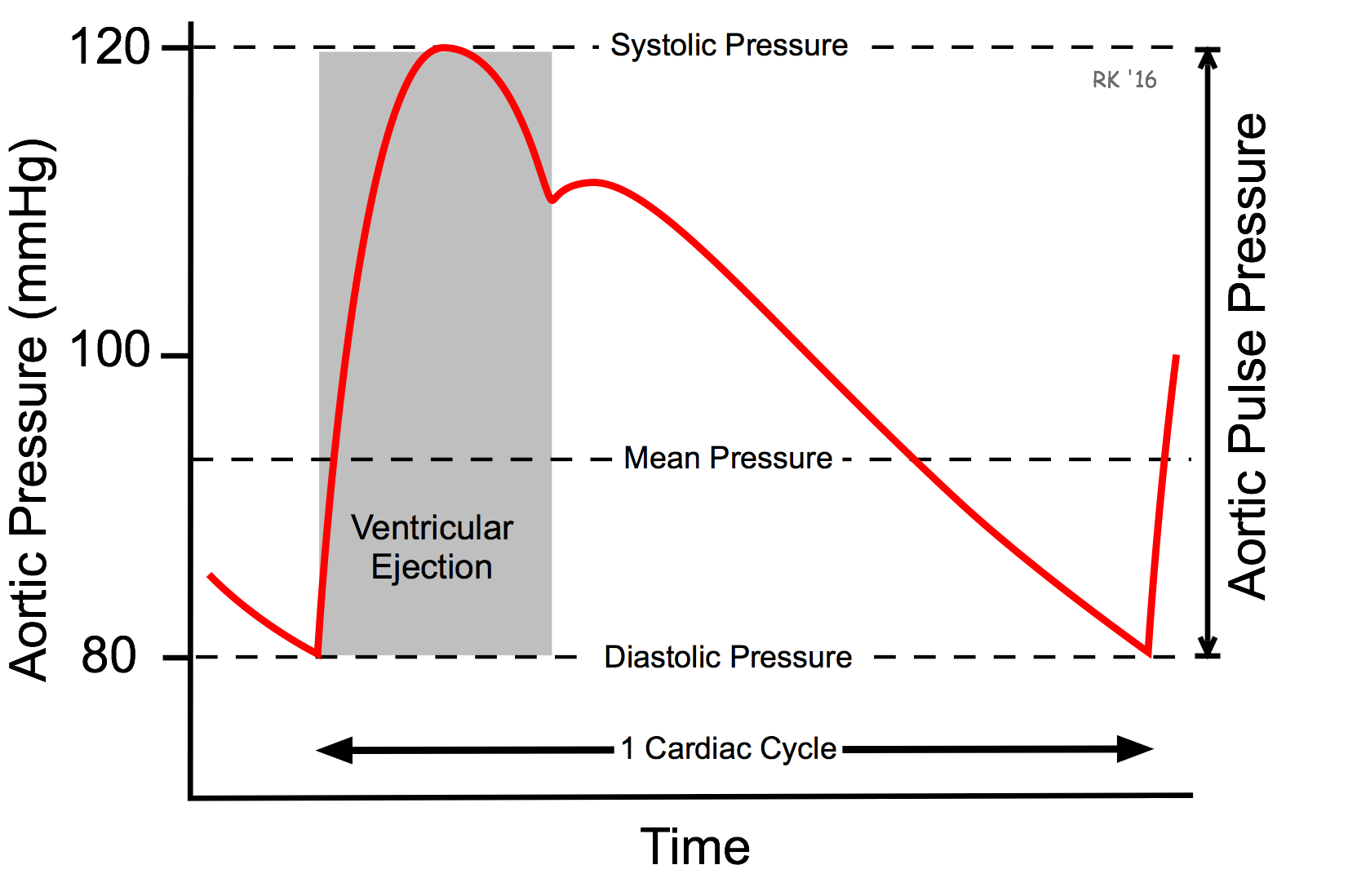 When the left ventricle ejects blood into the aorta, the aortic pressure rises. The maximal aortic pressure following ejection is termed the systolic pressure. As the left ventricle is relaxing and refilling, the pressure in the aorta falls. The lowest pressure in the aorta, which occurs just before the ventricle ejects blood into the aorta, is termed the diastolic pressure. When blood pressure is measured using a sphygmomanometer, the upper value is the systolic pressure and the lower value is the diastolic pressure. Normal systolic pressure is <120 mmHg, and normal diastolic pressure is <80 mmHg. The difference between the systolic and diastolic pressures is the aortic pulse pressure, which typically ranges between 40 and 50 mmHg. The mean aortic pressure is the average pressure (geometric mean) during the aortic pulse cycle.
When arterial pressure is measured using a sphygmomanometer (i.e., blood pressure cuff) on the upper arm, the systolic and diastolic pressures that are measured represent the pressure within the brachial artery, which differs slightly from the pressure found in the aorta or the pressure found in other distributing arteries. As the aortic pressure pulse travels down the aorta and into distributing arteries, there are characteristic changes in the systolic and diastolic pressures, as well as in the mean pressure. The systolic pressure rises and the diastolic pressure falls, therefore the pulse pressure increases as the pressure pulse travels away from the aorta. This occurs because of reflective waves from vessel branching and from decreased arterial compliance (increased vessel stiffness) as the pressure pulse travels from the aorta into systemic arteries. There is only a small decline in mean arterial pressure as the pressure pulse travels down distributing arteries because of the relatively low resistance of large distributing arteries.
Learn what determines mean arterial pressure.
Learn what determines systolic and diastolic pressures.
Revised 12/06/2022
 Twitter
 Telegram
 LinkedIn
 WhatsApp
 Facebook
 Reddit