 Cardiovascular Physiology Concepts, 3rd edition textbook, Published by Wolters Kluwer (2021)
 Normal and Abnormal Blood Pressure, published by Richard E. Klabunde (2013)
Cardiac Cycle - Rapid Ejection (Phase 3)
Aortic and Pulmonic Valves Open; AV Valves Remain Closed
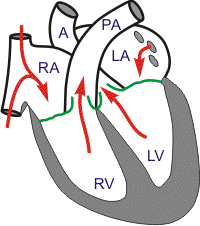
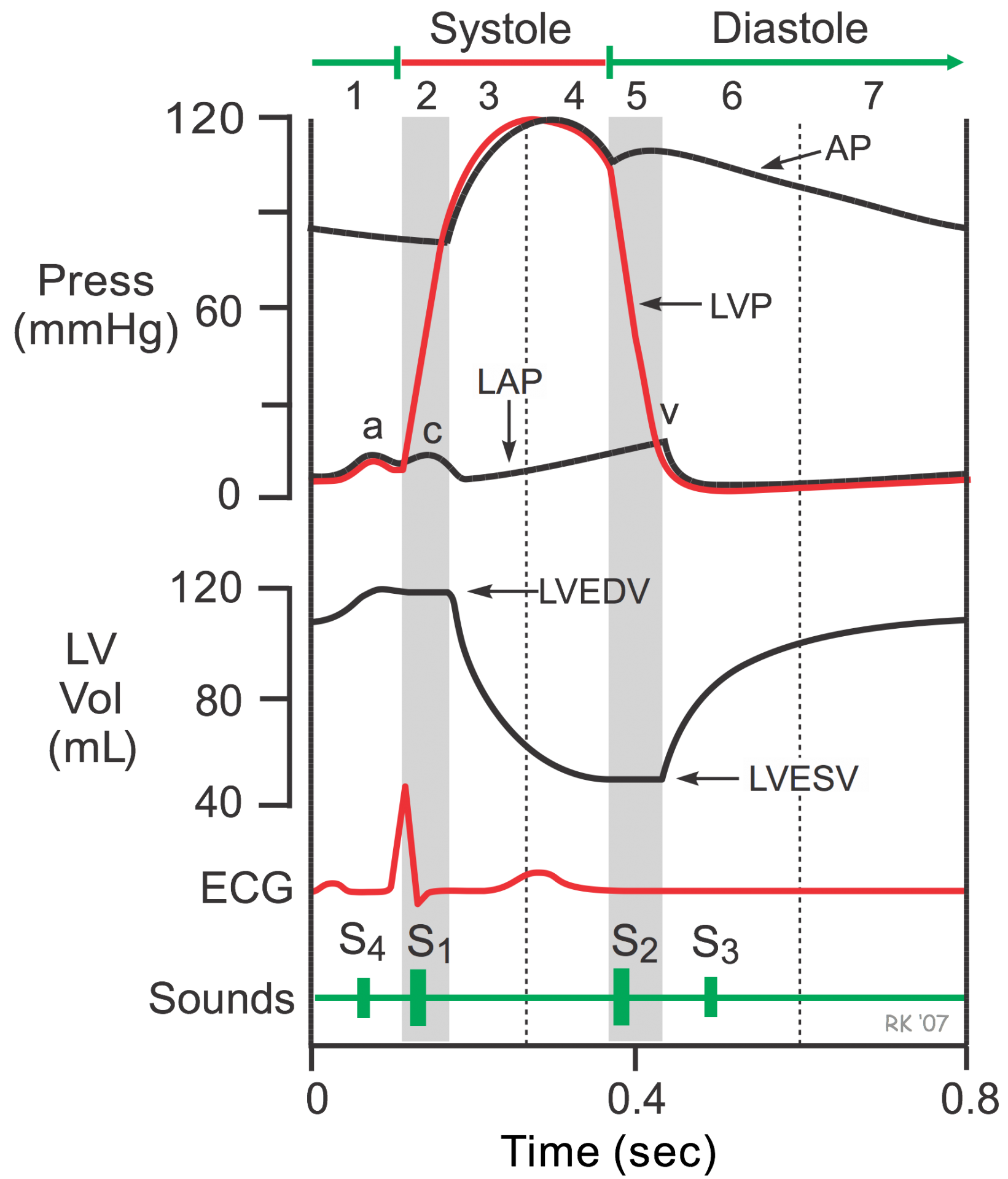 This third phase represents initial, rapid ejection of blood into the aorta and pulmonary arteries from the left and right ventricles, respectively. Ejection begins when the intraventricular pressures exceed the pressures within the aorta and pulmonary artery, which causes the aortic and pulmonic valves to open. Ejection occurs because the total energy of the blood within the ventricle exceeds the total energy of blood within the aorta. There is an energy gradient to propel blood into the aorta and pulmonary artery from their respective ventricles. During this phase, ventricular pressure normally exceeds outflow tract pressure by a few mmHg. Despite the high flow rate, the pressure gradient across the valve is ordinarily low because of the relatively large valve opening (i.e., low resistance). Maximal outflow velocity is reached early in the ejection phase, and maximal (systolic) aortic and pulmonary artery pressures are achieved.
No heart sounds ordinarily occur during ejection because the opening of healthy valves is silent. The presence of sounds during ejection (i.e., systolic murmurs) indicates valve disease or intracardiac shunts.
Left atrial pressure initially decreases (x'-descent) as the atrial base is pulled downward, expanding the atrial chamber. Blood continues to flow into the atria from their respective venous inflow tracts, and the atrial pressures begin to rise. This increase in pressure continues until the AV valves open at the end of phase 5.
Jump to other phases:
- Phase 1 - Atrial Contraction
- Phase 2 - Isovolumetric Contraction
- Phase 4 - Reduced Ejection
- Phase 5 - Isovolumetric Relaxation
- Phase 6 - Rapid Filling
- Phase 7 - Reduced Filling
Revised 11/04/2023
 Twitter
 Telegram
 LinkedIn
 WhatsApp
 Facebook
 Reddit