 Cardiovascular Physiology Concepts, 3rd edition textbook, Published by Wolters Kluwer (2021)
 Normal and Abnormal Blood Pressure, published by Richard E. Klabunde (2013)
Cardiac Cycle - Rapid Filling (Phase 6)
A-V Valves Open
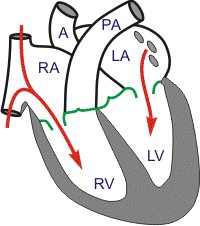
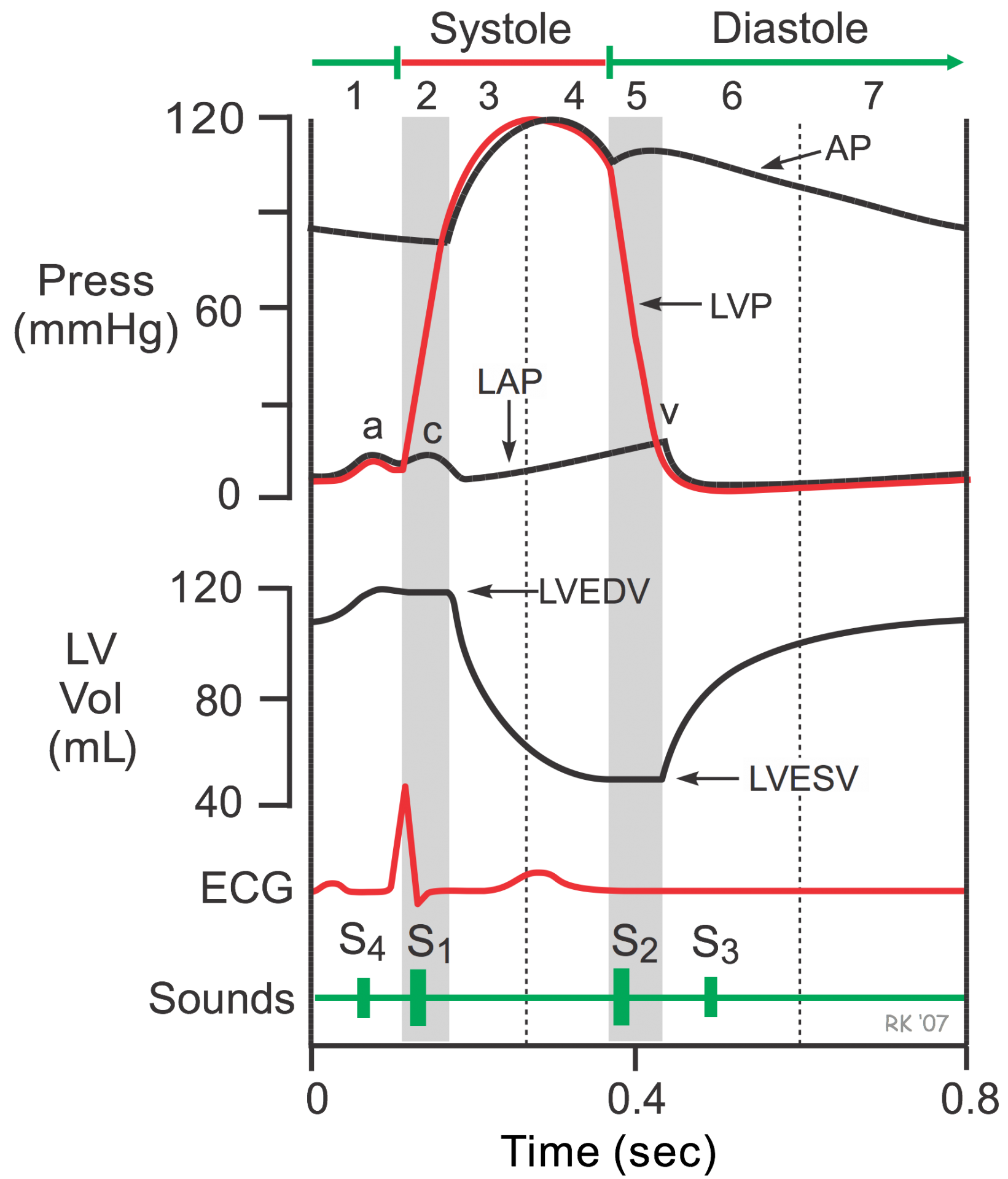 As the ventricles continue to relax at the end of phase 5, the intraventricular pressures will at some point fall below their respective atrial pressures. When this occurs, the AV valves rapidly open and rapid passive ventricular filling begins. Despite the inflow of blood from the atria, intraventricular pressure continues to briefly fall because the ventricles are still undergoing relaxation. Once the ventricles are completely relaxed, their pressures will slowly rise as they fill with blood from the atria.
The opening of the mitral valve causes a rapid fall in the left atrial pressure (LAP). The peak of the LAP just before the valve opens is the "v-wave." This is followed by the y-descent of the LAP. A similar wave and descent are found in the right atrium and in the jugular vein.
Ventricular filling is normally silent. When a third heart sound (S3) is audible during rapid ventricular filling, it may represent tensing of chordae tendineae and the atrioventricular ring during ventricular relaxation and filling. This heart sound is normal in children, but is often pathological in adults and caused by ventricular dilation.
Jump to other phases:
- Phase 1 - Atrial Contraction
- Phase 2 - Isovolumetric Contraction
- Phase 3 - Rapid Ejection
- Phase 4 - Reduced Ejection
- Phase 5 - Isovolumetric Relaxation
- Phase 7 - Reduced Filling
Revised 01/26/2023
 Twitter
 Telegram
 LinkedIn
 WhatsApp
 Facebook
 Reddit