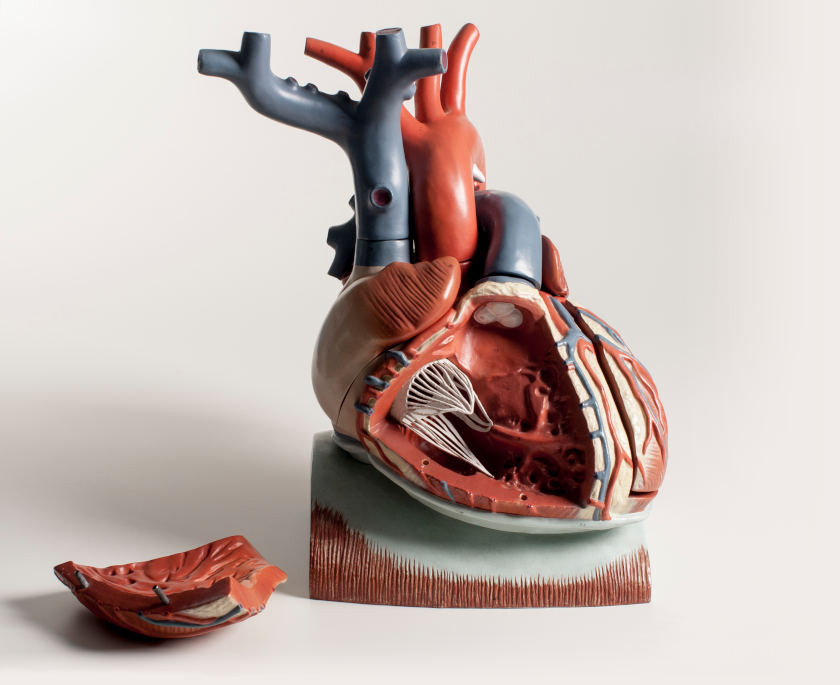
 Cardiovascular Physiology Concepts, 3rd edition textbook, Published by Wolters Kluwer (2021)
 Normal and Abnormal Blood Pressure, published by Richard E. Klabunde (2013)
Heart Sounds
When a stethoscope is placed on the chest over different regions of the heart, four basic heart sounds (S1, S2, S3 and S4) can be heard (listening to heart sounds is called cardiac auscultation). The sound waves responsible for heart sounds (including abnormal sounds such as murmurs) are generated by vibrations induced by valve closure, abnormal valve opening, vibrations in the ventricular chambers, tensing of the chordae tendineae, and by turbulent or abnormal blood flow across valves or between cardiac chambers (see heart anatomy).
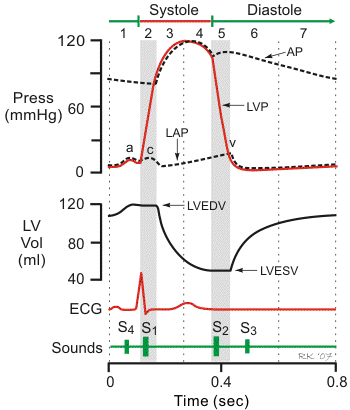 The most fundamental heart sounds are the first and second sounds, usually abbreviated as S1 and S2. S1 is caused by closure of the mitral and tricuspid valves at the beginning of isovolumetric ventricular contraction. S1 is normally slightly split (~0.04 sec) because mitral valve closure precedes tricuspid valve closure; however, this very short time interval cannot normally be heard with a stethoscope, so only a single sound is perceived. S2 is produced by the closure of the aortic and pulmonic valves at the beginning of isovolumetric ventricular relaxation, and the sound is physiologically split because aortic valve closure normally precedes pulmonic valve closure. This splitting is not of fixed duration. The timing of S2 splitting changes depending on the phase of respiration, body posture, and certain pathological conditions.
The third heart sound (S3), when audible, occurs early in ventricular filling, and may represent tensing of the chordae tendineae and the atrioventricular ring, which is the connective tissue supporting the AV valve leaflets. This sound is normal in children, but when heard in adults it is often associated with ventricular dilation as occurs in systolic ventricular failure.
The fourth heart sound (S4), when audible, is caused by the vibration of the ventricular wall during atrial contraction. This sound is usually associated with a stiffened ventricle (low ventricular compliance), and therefore is present in patients with ventricular hypertrophy, myocardial ischemia, or in older adults.
| Heart Sound | Occurs during: | Associated with: |
| S1 | Isovolumetric contraction | Closure of mitral and tricuspid valves |
| S2 | Isovolumetric relaxation | Closure of aortic and pulmonic valves |
| S3 | Early ventricular filling | Normal in children; in adults, associated with ventricular dilation (e.g. ventricular systolic failure) |
| S4 | Atrial contraction | Associated with stiff, low compliant ventricle (e.g., ventricular hypertrophy; ischemic ventricle) |
Besides these four basic heart sounds, other sounds such as murmurs can be heard. To learn more about these, click here.
Revised 01/26/2023
 Twitter
 Telegram
 LinkedIn
 WhatsApp
 Facebook
 Reddit