 Cardiovascular Physiology Concepts, 3rd edition textbook, Published by Wolters Kluwer (2021)
 Normal and Abnormal Blood Pressure, published by Richard E. Klabunde (2013)
Hemodynamics of a Valsalva Maneuver
When a person forcefully expires against a closed glottis, changes occur in intrathoracic pressure that dramatically affects venous return, cardiac output, arterial pressure, and heart rate. This forced expiratory effort is called a Valsalva maneuver.
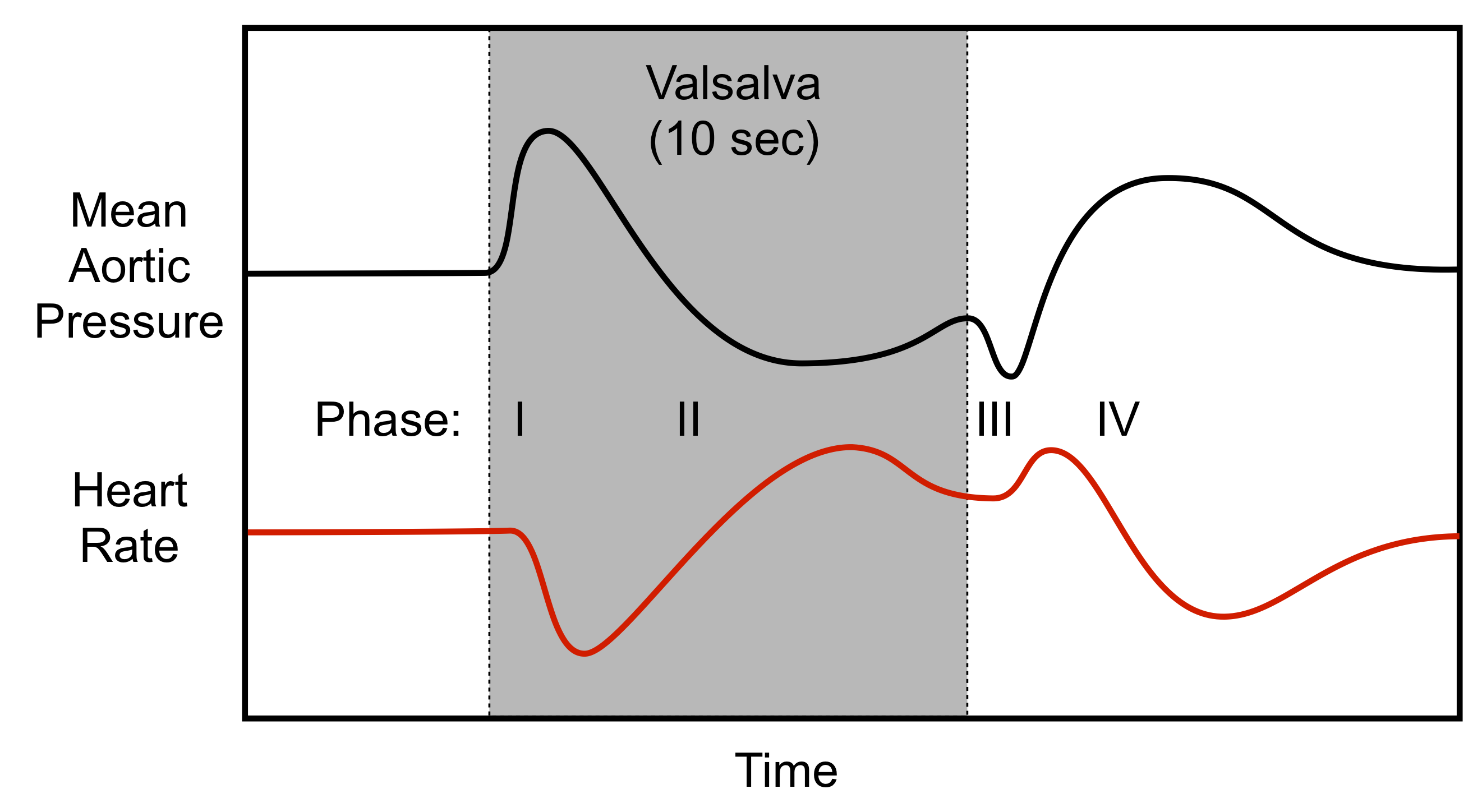 Initially, during a Valsalva, intrathoracic (intrapleural) pressure becomes very positive because of compression of the thoracic organs by the contracting rib cage. This increased external pressure on the heart and thoracic blood vessels compresses the vessels and cardiac chambers by decreasing the transmural pressure across their walls. Venous compression, and the accompanying large increase in right atrial pressure, impedes venous return into the thorax. This reduced venous return, and along with compression of the cardiac chambers, reduces cardiac filling and preload despite a large increase in intrachamber pressures. Reduced filling and preload leads to a fall in cardiac output by the Frank-Starling mechanism. Compression of the thoracic aorta transiently increases aortic pressure (phase I); however, aortic pressure falls (phase II) after a few seconds because cardiac output falls. Changes in heart rate are reciprocal to the changes in aortic pressure because of the operation of the baroreceptor reflex. During phase I, the heart rate decreases because aortic pressure is elevated; during phase II, the heart rate increases as the aortic pressure falls.
When the person breathes normally again, aortic pressure briefly decreases as the external compression on the aorta is removed, and the heart rate briefly increases reflexively (phase III). This is followed by an increase in aortic pressure and reflex decrease in heart rate (phase IV) as the cardiac output suddenly increases in response to a rapid increase in cardiac filling. Aortic pressure also rises above normal because of a baroreceptor, sympathetic-mediated increase in systemic vascular resistance that occurred during the Valsalva.
Similar changes occur whenever a person conducts a force expiration against either a closed glottis or high pulmonary outflow resistance, or when the thoracic and abdominal muscles are strongly contracted. This can occur when a person strains while having a bowel movement. Similar changes can also occur when a person lifts a heavy weight while holding their breath.
Revised 11/05/2023
 Twitter
 Telegram
 LinkedIn
 WhatsApp
 Facebook
 Reddit